
Your First Civilian Job Won’t Be Your Dream Job (And That’s OK)
Aug 18, 2026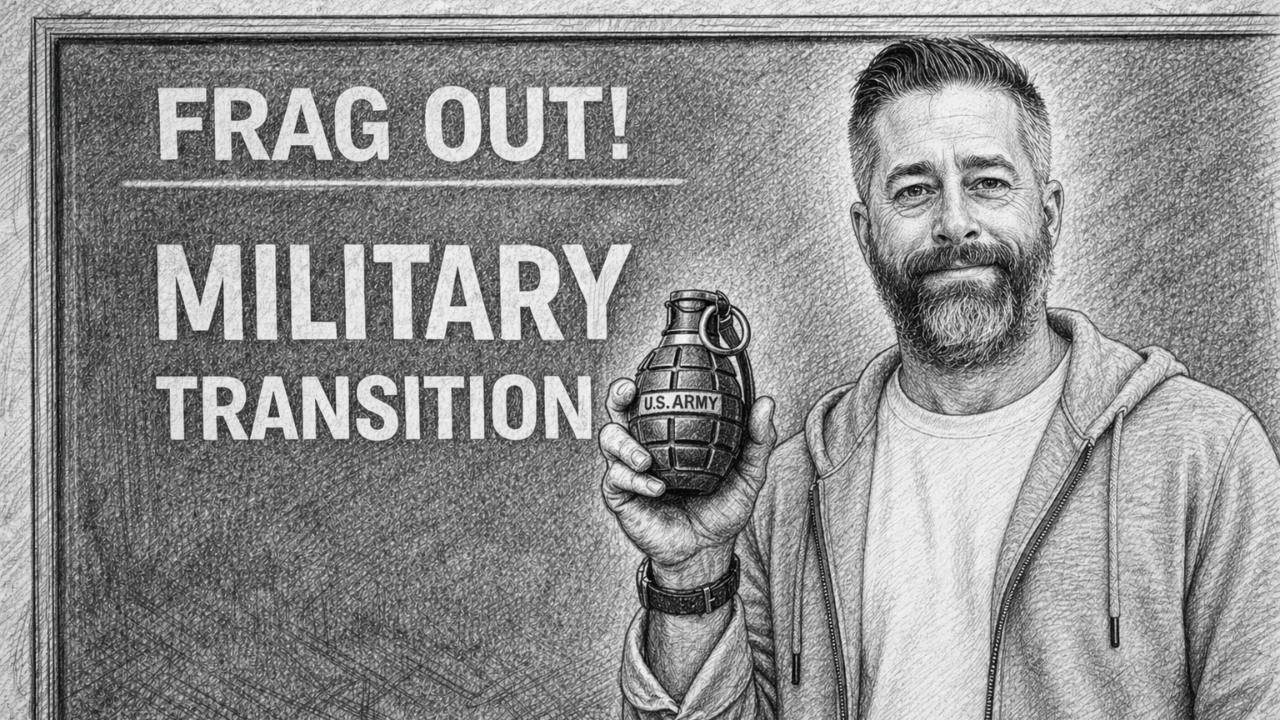
There’s a hard truth I wish more transitioning service members heard before they sign that first civilian offer letter: Your first job out of the military probably won’t be your dream job. And it doesn’t have to be.
I’m not saying this to discourage you. I’m saying it because nobody told me, and nobody told thousands of veterans before and after me. We step into the civilian world with hope, humility, and hustle… and then we’re blindsided by a simple, universal experience: Your first gig is often unfulfilling, awkward, sometimes miserable, and rarely aligned with your actual potential.
That doesn’t mean you chose wrong. It doesn’t mean you failed. It doesn’t mean you should resign yourself to misery.
It simply means you are transitioning. Like any mission, this phase has a purpose.
When you enter your first civilian job, you’ll quickly notice something: You’ve traded a cohesive, purpose-driven tribe… for an office environment where people complain about printer jams with the same urgency you once reserved for mission planning.
You will feel the difference immediately.
Most veterans report the same first impressions:
You won’t like the people. Not all of them. Maybe not any of them. You come from a culture built on accountability, trust, competence, and shared suffering. Civilians come from… varied circumstances. Some are wolves. Some are sheep. Most are just normal people doing normal jobs.
You’ll feel underutilized. The military asks you to operate at 100% of your ability (often more). The civilian world often asks you to operate at about… 33%. You’ll be shocked at how many people consider “sending an email” a deliverable worth celebrating.
You’ll feel underpaid. This one stings. You brought decades of discipline, leadership, risk management, and problem-solving to the table… and the salary offer might look like someone’s idea of a prank.
Welcome to the transition. This isn’t a failure. This is the baseline.
And acknowledging that truth will keep you sane.
Stop treating your first job like a marriage. One of the strangest phenomena in the veteran world is this misguided, unwavering loyalty some service members carry into their first civilian job.
You get an offer. You accept. And suddenly (because military conditioning runs deep) you treat that company like a new chain of command. You treat your boss like a CO. You treat your first role like you just signed a six-year enlistment.
Let me be clear: You don’t owe your first civilian employer a damn thing beyond doing the job with integrity while you’re there.
This isn’t a battalion. It’s a business.
And here’s where I’ll give you a joke that’s only half a joke: The only permanent record of your civilian employment exists in two places: LinkedIn and the IRS.
And nobody reads either of those the way you think they do.
That toxic boss you’re afraid to leave? He doesn’t follow you. That miserable entry-level role? It doesn’t define you. That job title that feels beneath you? No one cares once you move on.
Your military record mattered forever. Your civilian job record matters only until you trade up.
Here’s the mindset shift that changes the transition: Your first job isn’t the destination. It’s the LZ.
It’s simply where you touch down after the bird drops you off.
Its purpose is tactical: Build civilian credibility. Translate military skills into civilian language. Understand the business environment. Learn what you actually want (and what you absolutely don’t).
You’re not meant to stay in your first job forever. You’re meant to learn from it.
Think about any operation you’ve ever executed. You don’t land on an LZ and set up permanent living quarters. You land, get oriented, move to the objective, and execute.
Your first job works the same way.
But too many veterans confuse the LZ with the objective. They land and think, “Well… guess this is it.”
No. This is just the drop-off point. You still have movement to do.
Transitioning veterans often stay in miserable jobs because they equate discomfort with commitment. “I can’t leave. I haven’t been here long enough.” “I don’t want to look like a job hopper.” “I feel bad walking away from the team.” “They rely on me.” “I don’t want to burn bridges.”
Let me stop you right there.
This isn’t the military. There is no “needs of the Army.” There is no “good order and discipline.” There is only one truth: If you’re miserable, it’s your responsibility (and your right) to move.
Staying miserable out of misplaced loyalty is not noble. It’s self-destructive.
Your family didn’t sacrifice your deployments, late nights, and missed moments so you could spend the next decade hating your life in a cubicle.
You didn’t get blown up, cold, tired, hungry, sunburned, shot at, and stressed out for years just to “tough out” a mediocre middle-management role.
Your service earned you the right to pursue something better.
Almost every veteran (enlisted, officer, SOF, conventional, combat arms, support, doesn’t matter) feels this one deeply: “I’m capable of so much more than this job requires.”
That’s not arrogance. That’s experience. When you’ve been responsible for lives, missions, millions of dollars in equipment, and decisions that actually mattered… it feels ridiculous to be micromanaged by someone who freaks out over minor admin tasks.
But hear this clearly: Underutilization in your first job is normal. It does not reflect your value.
It reflects your new environment’s inability to recognize or deploy your capabilities yet.
Think back to your first day in your first military unit. Did they hand you the most complex missions on day one? No. You earned that over time.
Your first civilian job isn’t where the world recognizes your full potential. It’s where you learn how to position your value in a way the civilian world understands.
Your skills are real. You’re not behind. You’re not broken. You’re untranslated.
Instead of viewing your first civilian job as a judgment on your worth, view it as a calibration tool.
Ask yourself: What do I enjoy doing here? What drains me? What skills do I want to use more? What am I naturally better at than others? What parts of this company do I admire? What parts make me want to run screaming into the woods? What type of leader do I want to follow? What type of leader do I refuse to follow? What environment brings out my best?
This information isn’t available until you’re in the civilian world.
Your first job provides the data. Your next job leverages it.
Your dream job doesn’t appear on day one. It emerges through: Iteration. Networking. Experience. Honest self-reflection. Taking some wrong turns. Taking some right ones
Your first job is the first iteration. It’s not the final destination. It’s not the ceiling of your abilities. It’s not your forever home.
It’s simply Step 1. Your dream job is usually Step 3 or Step 4… sometimes Step 9.
Transition is a process, not a single decision.
You’ve sacrificed too much to be miserable now! This is where I’m blunt: You spent years (often decades) serving others. You sacrificed comfort, time, safety, health, and pieces of your soul. Your family sacrificed right alongside you.
You earned the right to pursue a career that:
Brings you joy (yes, I said ‘joy’, get over it).
Respects your time (we all only get one ride on the roller coaster called ‘life’).
Uses your strengths (yes, you have them, find them and use them to your advantage).
Challenges you (don’t stagnate and die in place).
Values you and pays you fairly (both monetarily and quality of life).
Aligns with who you’re becoming (you are a work in progress).
If your first civilian job doesn’t give you that? Don’t stay out of habit. Don’t stay out of fear. Don’t stay because your military conditioning tells you quitting is weakness.
Quitting a bad job is strength. Leaving a toxic environment is discipline. Walking toward a better opportunity is leadership.
Transition doesn’t end when you get your first job. It ends when you find a role (and a workplace) that allows you to live a life worthy of everything you endured to get here.
If you take nothing else from this newsletter, take this: Your first civilian job is not your identity. It’s your starting point.
You don’t have to love it. You don’t have to stay long. You don’t have to prove loyalty to people who haven’t earned it. You don’t have to tolerate toxicity. You don’t have to be miserable.
You owe yourself more than that. You’ve earned more than that. Your service paid the upfront cost.
Now it’s time to build the life you actually want. And if your first job out of the military isn’t that life?
Good. It means you’re normal. It means you’re learning. It means you’re ready for the next step.
Frag out, keep moving, stay dangerous, and never settle.
DOL.
Stay connected with news and updates!
Join our mailing list to receive the latest news and updates from our team.
Don't worry, your information will not be shared.
We hate SPAM. We will never sell your information, for any reason.